
What Are Microworms? Benefits for Fry & Adult Fish in Australia
In this article, we go more in depth into the many benefits of live foods, exploring how they support growth, survival rates, natural behaviours, and overall long-term health across all life stages of aquarium fish. If you’re short on time or prefer quick takeaways, each section of this article includes dot-point summaries highlighting the key benefits and facts about microworms and live foods.
Contents
What Are Microworms? Benefits for Fry & Adult Fish in Australia
How Microworms & Live Foods Improve Fry Growth and Survival
Adult Fish Benefits: Why Microworms Should Be Part of Your Diet
Why Live Foods Like Microworms Outperform Dry & Prepared Foods
Microworms vs Brine Shrimp: The Best Live Food for Fish Kept in Australia
Why Keeping a Microworm Culture on Hand Matters
What are Micro-worms and how are they useful?
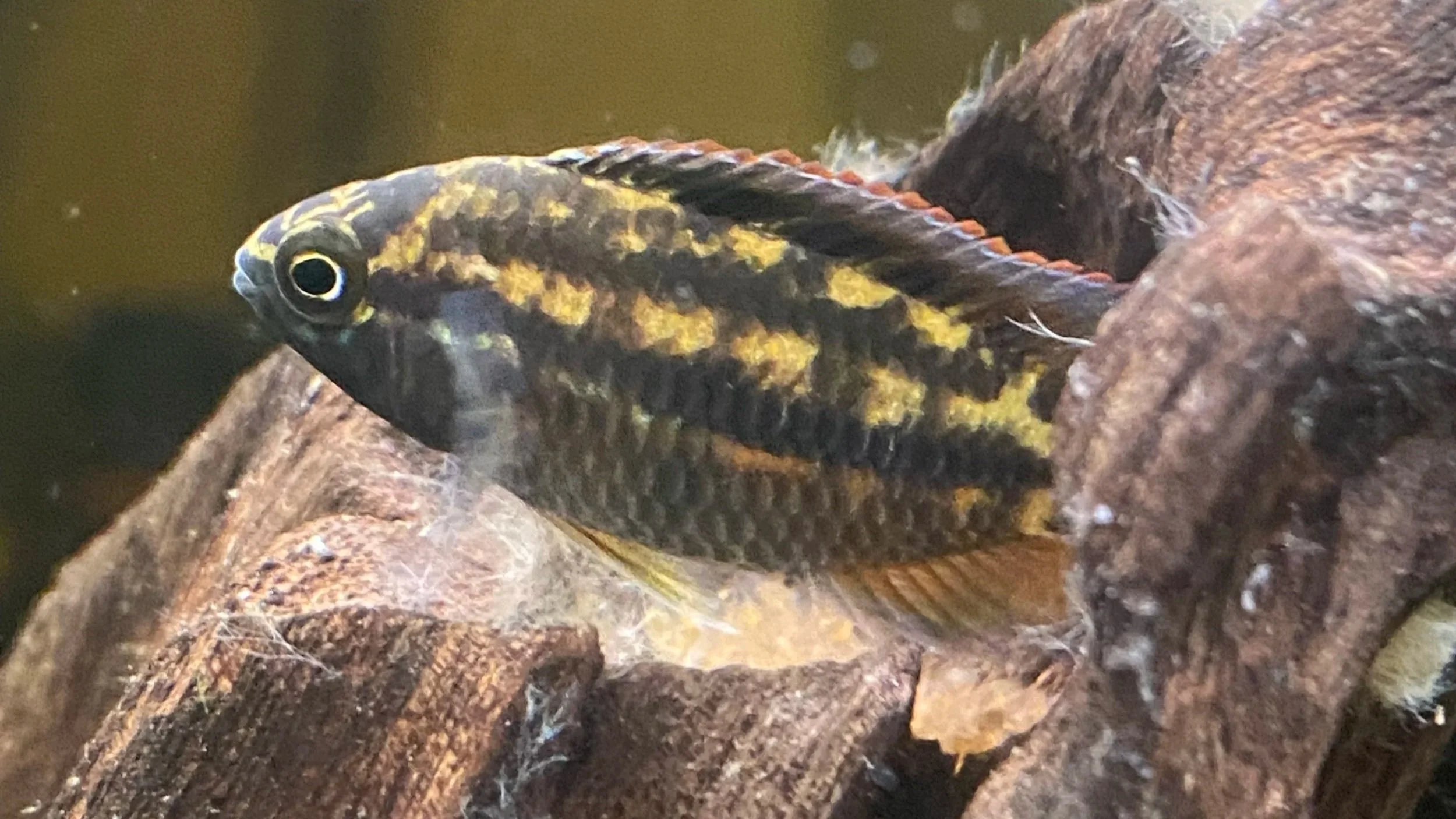
Female Blue Golden Eye Dwarf Cichlid (Nanacara Anomala) - Guarding her freshly hatched fry/wrigglers
Are you an Australian fishkeeper ready to get started? Click the image above to begin your own live microworm culture today!
Microworms are free-living nematodes widely used in aquaculture and the aquarium hobby as a live food source. Measuring approximately 1–2 mm in length, they are small, soft-bodied, and easy to consume, making them suitable not only for fish fry and juveniles, but also for many small adult fish species.
One of the key advantages of microworms is their slow, undulating movement and sinking behaviour. Rather than rapidly swimming to the surface like newly hatched brine shrimp, microworms remain suspended throughout the water column before settling on surfaces and the substrate. This keeps them accessible to fish that naturally feed lower in the tank and closely mimics the microfauna many species encounter in the wild.
Because microworms move slowly and cannot actively escape, fish expend far less energy capturing and consuming them. This makes them especially valuable during early development, recovery, or conditioning, when efficient energy use directly impacts growth, health, and survival. Fry and small fish are able to feed consistently rather than relying on chance encounters with fast-moving prey.
While microworms are often associated with fry, their benefits extend well beyond early life stages. For adult fish, microworms act as a highly digestible live protein source that stimulates natural feeding behaviours, encourages strong appetites, and helps diversify the diet. Live foods like microworms engage hunting instincts, improve feeding responses, and contribute to better overall condition when used alongside prepared and frozen foods.
Although brine shrimp are more nutritionally dense, microworms play a complementary role by ensuring food is actually captured and eaten efficiently. Used together, they provide both accessibility and nutritional richness, supporting healthier fish across all life stages rather than serving a single purpose.
Key Takeaways: Microworms & Their Benefits
Microworms (Panagrellus redivivus) are small, soft-bodied nematodes (1–2 mm) suitable for fry, juveniles, and many small adult fish.
Their slow, undulating movement and sinking behaviour make them accessible to fish that feed lower in the tank.
Fish expend less energy feeding on microworms, supporting faster growth, better health, and higher survival rates.
Microworms provide a digestible live protein source for adult fish, stimulating natural feeding behaviours and improving overall condition.
Complementary to brine shrimp — microworms ensure food is efficiently eaten, while brine shrimp add nutritional richness.
Ideal for supporting healthier fish across all life stages, from fry to adults, in both breeding and community aquariums.
How Microworms & Live Foods Improve Fry Growth and Survival
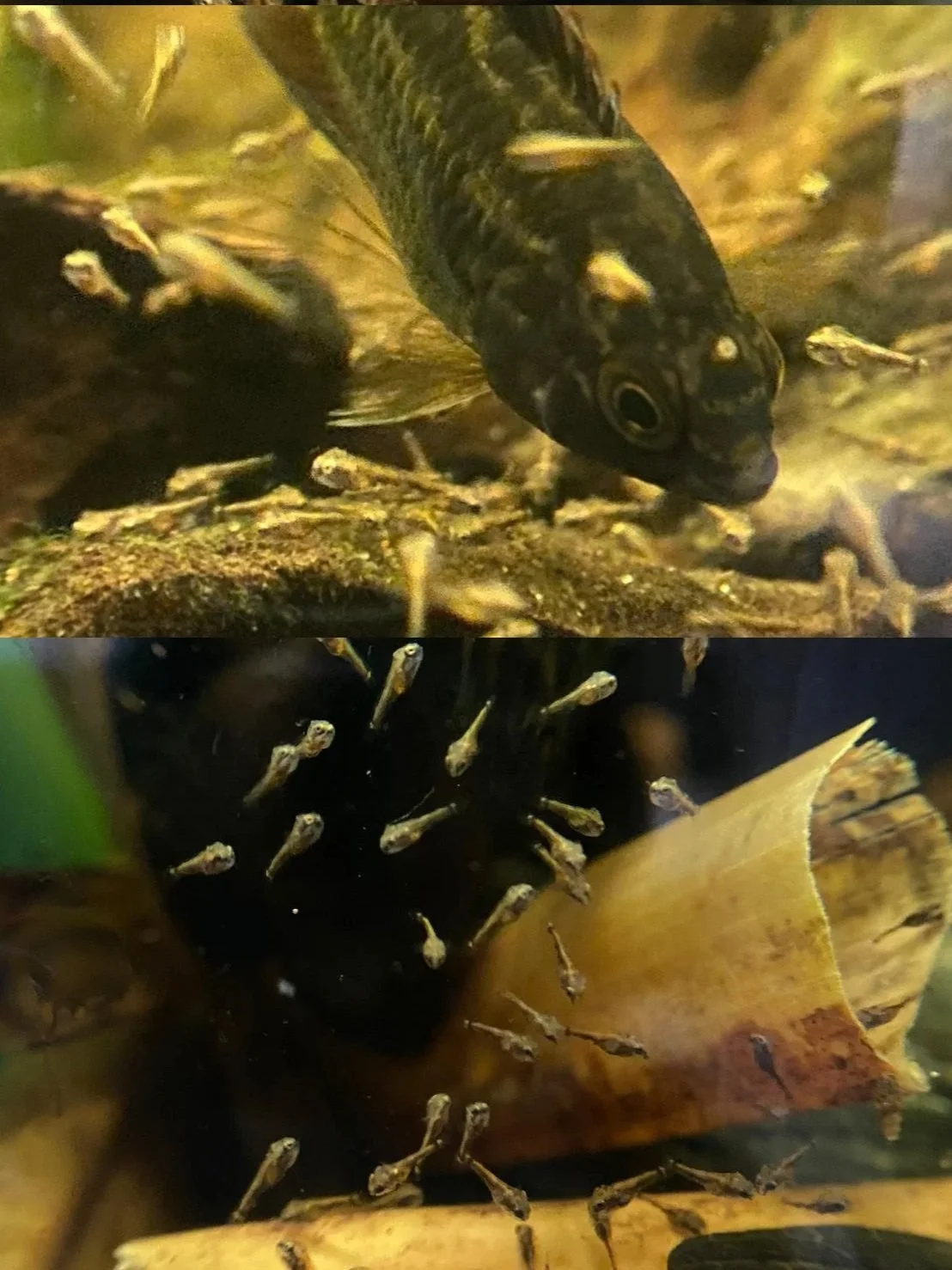
Free Swimming Blue Golden Eye Dwarf Cichlid (Nanacara Anomala)
How Live Foods Increase Fry Survival
The first days after yolk sac absorption represent the highest mortality risk in a fish’s life. At this stage, fry have limited energy reserves, immature digestive systems, and poorly developed feeding coordination. Microworms directly reduce mortality during this critical window by matching the biological and behavioural limitations of newly free-swimming fry.
Unlike inert foods, microworms remain alive in the water and move continuously. This sustained movement repeatedly triggers the fry’s innate prey-capture response, increasing feeding success even in weaker or slower individuals. Because the food remains available for extended periods, fry are not dependent on a single feeding event, reducing starvation-related losses.
Once ingested, microworms are easier to digest than dry or frozen alternatives. Their soft, non-chitinous bodies break down readily, and their endogenous enzymes assist in tissue degradation within the gut. This results in higher nutrient absorption efficiency at a time when fry are unable to fully digest complex or denatured proteins.
Together, these factors significantly improve early survival rates by ensuring consistent energy intake during the most vulnerable developmental stage.
Key Takeaways:
The first days after yolk sac absorption are the highest-risk period for fry mortality.
Microworms match the feeding abilities and limitations of newly free-swimming fry.
Continuous movement of live microworms triggers innate prey-capture behaviours, improving feeding success.
Food remains available for extended periods, reducing reliance on single feeding events and starvation risk.
Soft, easily digestible bodies and endogenous enzymes improve nutrient absorption during early development.
Overall, consistent energy intake from microworms significantly increases fry survival rates.
Effects on Growth Rate and Size Uniformity
Rapid early growth is one of the strongest predictors of long-term fry survival. Microworms support accelerated growth by providing highly bioavailable protein and lipids in a form that fry can efficiently assimilate.
Live foods stimulate the release of digestive enzymes through active feeding behaviour, accelerating gut maturation and improving digestive efficiency. Fry fed microworms transition more quickly from reliance on simple nutrients to processing more complex diets, allowing earlier weaning onto larger live or prepared foods.
Because microworms are continuously available and evenly distributed throughout the water column, feeding is less competitive. This reduces size disparities within broods, leading to more uniform growth. Size uniformity is critical, as large size differences increase stress, dominance suppression, and cannibalism in some species.
Consistent access to live food allows fry to allocate more metabolic energy toward somatic growth rather than basic maintenance, resulting in stronger musculature, better body condition, and faster development through juvenile stages.
Early rapid growth is a strong predictor of long-term fry survival.
Microworms provide highly bioavailable protein and lipids that fry can efficiently assimilate.
Live food stimulates digestive enzyme release, accelerating gut maturation and digestive efficiency.
Fry transition more quickly to complex diets, allowing earlier weaning onto larger live or prepared foods.
Continuous availability and even distribution reduce competition, promoting size uniformity within broods.
Uniform growth minimizes stress, dominance hierarchies, and cannibalism.
Consistent access to microworms allows fry to allocate energy toward growth, building stronger musculature and better body condition.
Long-Term Outcomes
Fry raised on live foods such as microworms during early development consistently show higher resilience, improved feeding efficiency, and reduced losses during later transitions. By supporting both immediate survival and rapid early growth, microworms play a foundational role in producing healthy, robust juveniles rather than simply keeping fry alive.
Fry fed microworms early show higher resilience and overall hardiness.
Live foods improve feeding efficiency during growth and diet transitions.
Early access to microworms reduces losses during later developmental stages.
Supports both immediate survival and rapid early growth, producing healthier, more robust juveniles.
Microworms help set a strong foundation for long-term fish health, not just short-term survival.
Adult Fish Benefits: Why Microworms Should Be Part of Your Diet
Nutritional Diversity & Dietary Balance
In the wild, most freshwater fish consume a wide range of live prey rather than a single, uniform food source. Offering microworms introduces a different protein and lipid profile than flakes, pellets, or frozen foods, helping to diversify nutrient intake and reduce reliance on any one food type.
Microworms provide highly digestible animal protein in a soft-bodied form that places minimal strain on the digestive system. This makes them especially valuable during periods of increased metabolic demand, such as conditioning, recovery, or post-spawning. Regular inclusion of live foods supports better overall condition and helps prevent nutritional gaps that can occur in monotonous diets.
Diversifies diet with different protein and lipid profiles.
Highly digestible, soft-bodied live protein.
Supports conditioning, recovery, and post-spawning health.
Helps prevent nutritional gaps from monotonous diets.
Breeding Conditioning & Reproductive Output
Live foods play a direct role in reproductive readiness. Feeding microworms increases energy intake without overloading the gut, allowing fish to allocate more resources toward gonadal development rather than basic maintenance.
The high digestibility of microworms supports efficient conversion of nutrients into eggs and milt, improving egg volume, fertilisation rates, and overall spawning consistency. For many species, consistent access to live foods shortens the conditioning period required before spawning and supports repeat spawns with less decline in adult condition.
Microworms are particularly useful as a conditioning food for small to medium species that may struggle with larger live foods, ensuring even smaller individuals receive adequate nutrition.
Increases energy intake for gonadal development without overloading the gut.
Highly digestible, supporting efficient egg and milt production.
Improves egg volume, fertilisation rates, and spawning consistency.
Shortens conditioning periods and supports repeat spawns.
Ideal for small to medium species that struggle with larger live foods.
Triggering Natural Feeding & Hunting Behaviours
Unlike static prepared foods, microworms move continuously in the water column, stimulating natural prey-detection and hunting responses. This behavioural engagement encourages active feeding, improves appetite, and reduces selective feeding or food refusal in established tanks.
Engaging natural behaviours has measurable benefits beyond enrichment. Active feeding promotes digestive enzyme release, improves nutrient absorption, and supports better gut function. Fish that regularly consume live foods tend to feed more confidently and transition more easily between different food types.
This behavioural stimulation is particularly beneficial for species that are slow, cautious, or easily outcompeted at feeding time.
Appetite Stimulation & Recovery Support
Microworms are highly palatable and readily accepted, even by fish that are stressed, newly introduced, or recovering from illness. Their movement and scent profile make them an effective appetite stimulant when fish are reluctant to eat dry foods.
Because they are soft-bodied and easy to digest, microworms provide accessible energy without contributing to digestive blockage or waste buildup. This makes them suitable for short-term supportive feeding while fish regain strength and normal feeding behaviour.
Continuous movement of microworms stimulates natural hunting and prey-detection behaviours.
Encourages active feeding and reduces selective feeding or food refusal.
Promotes digestive enzyme release and improves nutrient absorption.
Supports smoother transitions between different food types.
Particularly beneficial for slow, cautious, or easily outcompeted fish.
Supporting Long-Term Health Through Live Food Rotation
While microworms should not replace a complete staple diet, rotating them alongside other live, frozen, and prepared foods closely mirrors natural feeding patterns. This rotation supports better metabolic flexibility, more stable body condition, and improved long-term health.
Incorporating microworms as part of a varied feeding schedule helps maintain interest in food, supports breeding condition, and promotes natural behaviours—key factors in keeping adult fish thriving rather than simply surviving.
Even if you aren’t actively breeding, keeping a microworm culture on hand ensures you’re always prepared for unexpected spawns, conditioning periods, sick fish with no appetite or fish that refuse dry foods.
Should complement, not replace, a complete diet — supports natural feeding patterns.
Rotation with other foods promotes metabolic flexibility, stable condition, and long-term health.
Maintains interest in food and supports breeding condition and natural behaviours.
Always prepared for unexpected spawns, sick fish, or fish refusing dry foods.
Provides a reliable, low-maintenance live food option for all life stages.
Microworms vs Brine Shrimp: The Best Live Food for Fish Kept in Australia
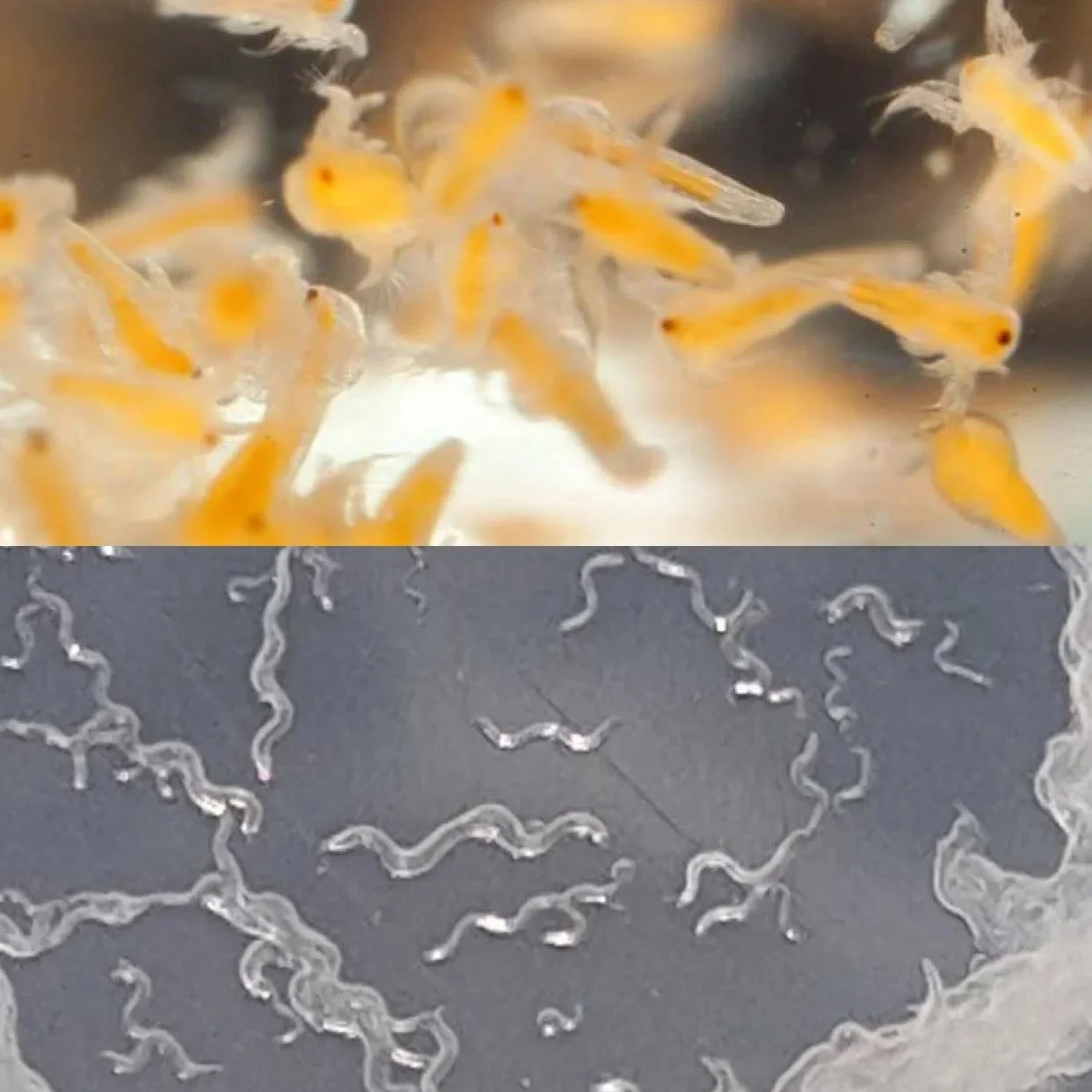
Freshly Hatched Brine Shrimp Top Microworms Bottom
Microworms and newly hatched brine shrimp are two of the most commonly used live foods in the aquarium hobby, but they behave very differently in the water and serve distinct roles when raising fish.
Brine shrimp (Artemia nauplii) are highly nutritious at the moment of hatching, providing a rich source of lipids that support rapid growth once fry are capable of actively hunting. However, they are fast swimmers and strongly phototactic, meaning they quickly move upward in the water column. For many species—particularly dwarf cichlids, cave spawners, and bottom-oriented fry—this places brine shrimp largely out of reach during the earliest free-swimming stages.
In addition, brine shrimp require constant hatching cycles to remain effective. Their nutritional profile begins to decline significantly within the first hour after hatching as they consume their own yolk reserves, and they grow rapidly beyond optimal fry size. This means they cannot be stored or reused, and any uneaten shrimp quickly become unsuitable as a food source.
Microworms, by contrast, offer a true set-and-forget live food option. They move slowly with a gentle, undulating motion and sink gradually through the water column before settling on surfaces and the substrate. This makes them far more accessible to fry that naturally graze along the bottom or lack the speed and coordination to chase mobile prey.
Because microworms are naturally small and fully grown at that size, they do not outgrow fry, and their nutritional profile remains stable. They cannot actively escape, allowing fry to feed with minimal energy expenditure. This efficiency enables more energy to be directed toward growth and development rather than constant pursuit.
From a husbandry standpoint, microworm cultures require very little ongoing effort. Once established, a culture can be maintained with light feeding and attention only every 2–4 weeks, providing a continuous, on-demand supply of live food without daily preparation, timing, or waste.
While brine shrimp offer higher peak nutrition, it’s important to consider that a portion of that energy is lost when fry must repeatedly chase fast-moving prey or when shrimp are no longer nutritionally optimal. Microworms help bridge this gap by ensuring food is consistently available, captured, and consumed—particularly during the most fragile early stages of life.
For best results when raising fry, both microworms and brine shrimp should be used together. Microworms provide reliable, low-effort feeding when fry are small or bottom-oriented, while brine shrimp can be introduced as fry grow stronger and more capable hunters. Used in combination, they deliver both accessibility and nutritional richness, supporting healthier growth and higher survival rates.
Microworms and brine shrimp each serve an important role, but microworms offer unmatched reliability, accessibility, and ease of use. Their slow movement, bottom availability, stable size, and low-maintenance “set and forget” culturing make them an essential live food—especially during the earliest and most critical stages of fry development.
While brine shrimp provide higher peak nutrition, they require constant hatching and lose value quickly if not used immediately. Keeping a microworm culture ensures you always have live food available when fry need it most, without the pressure of timing or daily preparation.
For the best results, serious fish keepers use both—microworms for consistent, low-effort feeding and brine shrimp to boost nutrition as fry grow and hunting ability improves.
Brine shrimp are highly nutritious at hatching but fast-moving, making them hard for small or bottom-feeding fry to catch.
Brine shrimp require constant hatching; nutritional value declines quickly and uneaten shrimp cannot be reused.
Microworms are slow, fully grown at fry-appropriate size, and sink gradually, making them easy for fry to access.
Fry expend less energy feeding on microworms, allowing more energy for growth and development.
Microworm cultures are low-maintenance, requiring attention only every 2–4 weeks.
Using both together is ideal: microworms provide reliable, low-effort feeding for small fry, while brine shrimp boost nutrition as fry grow stronger.
Microworms offer unmatched reliability, accessibility, and ease-of-use, especially during the most critical early stages.
Why Live Foods Like Microworms Outperform Dry & Prepared Foods
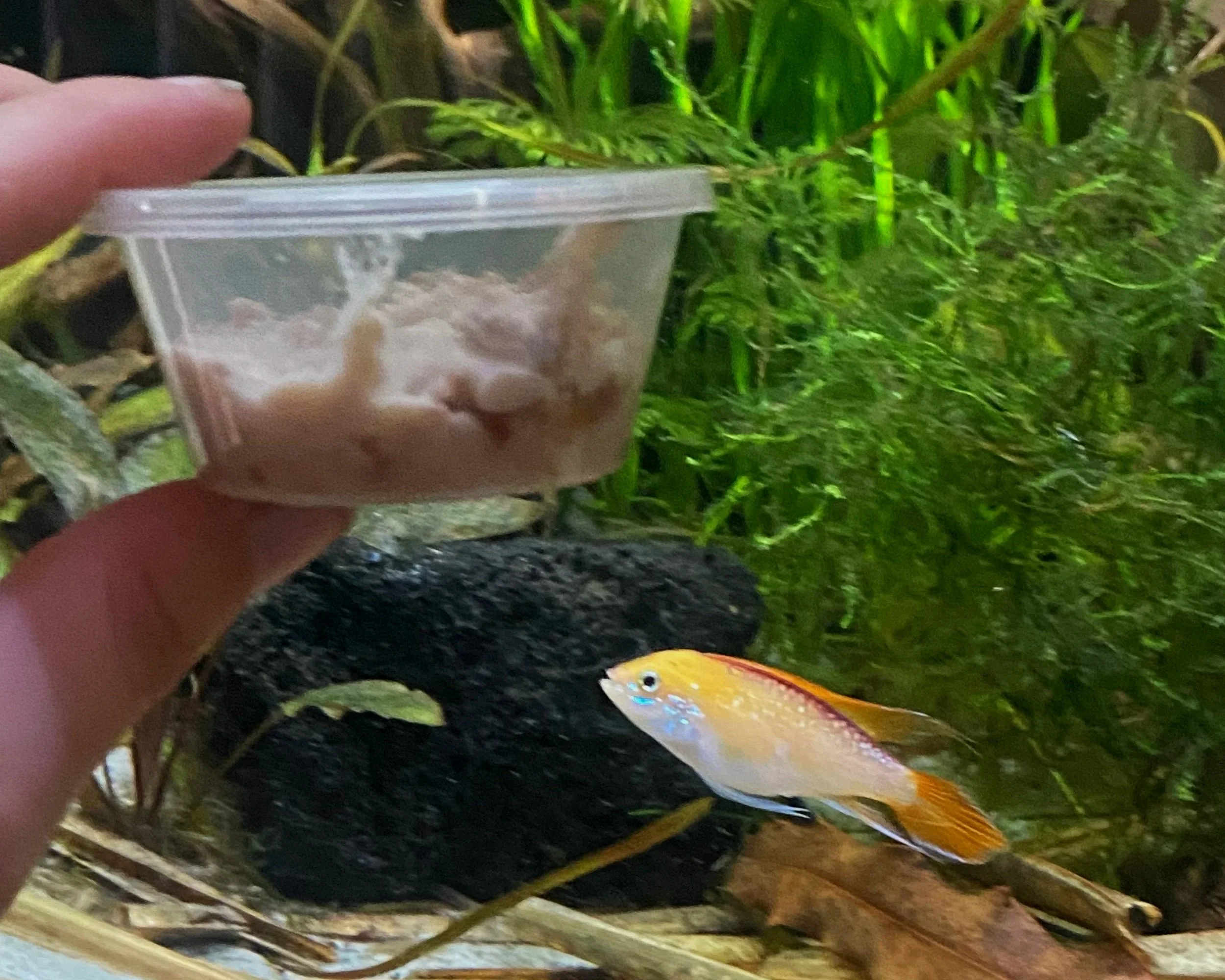
Freshly set up microworm starter culture and my male Apistogramma Agassizii click the image above to get your own culture started.
Live foods play a fundamentally different role in fish nutrition compared to dry or prepared foods. In natural environments, freshwater fish do not consume static, processed diets—they feed on moving prey such as insect larvae, microcrustaceans, worms, and other small invertebrates. Live foods replicate this natural feeding dynamic far more closely than flakes or pellets, aligning with both the behavioural and physiological adaptations of aquarium fish.
One of the most immediate advantages of live food is its ability to trigger natural feeding responses. Movement stimulates prey-detection instincts, increasing feeding motivation and reducing hesitation or food refusal. This behavioural stimulation is especially important for shy, stressed, or newly introduced fish, as well as species that are easily outcompeted during feeding. Active feeding not only improves intake but also prepares the digestive system for efficient nutrient processing.
From a physiological perspective, live foods promote significantly improved digestion and nutrient absorption. The act of pursuing and consuming live prey stimulates the release of gastric acids and digestive enzymes, including proteases and lipases. This increased enzymatic activity allows fish to break down proteins and fats more effectively, resulting in higher nutrient assimilation per feeding event. Dry foods, particularly those that swell or degrade quickly in water, may pass through the digestive tract with reduced utilisation—especially in fry, juveniles, and species with short or sensitive digestive systems.
Live foods also provide nutrients in their most biologically intact and bioavailable forms. Unlike processed foods, which are exposed to heat, pressure, and oxidation during manufacture, live prey retain naturally occurring amino acids, fatty acids, enzymes, and micronutrients in forms closely aligned with the evolutionary diet of freshwater fish. These intact nutrients support stronger growth, improved immune function, better tissue repair, and more stable metabolic performance. During periods of high demand—such as rapid growth, recovery from stress, or reproductive conditioning—live foods help meet nutritional needs without overloading the digestive system.
Another major advantage of live foods is their impact on waste reduction and water quality stability. Because live prey actively move and stimulate feeding responses, they are consumed more quickly and in more appropriate amounts. This reduces uneaten food breakdown, limits excess nutrient release into the water, and lowers the risk of ammonia spikes and bacterial blooms. Fish feeding on live foods also tend to self-regulate intake more effectively than when fed static dry foods, further supporting stable water parameters.
Finally, regular inclusion of live foods contributes to long-term health, behavioural enrichment, and overall resilience. Fish that engage in natural feeding behaviours exhibit better body condition, more consistent growth, stronger breeding responses, and reduced stress-related issues. Live foods are not simply a supplement to dry diets—they are a functional tool for maintaining fish that thrive rather than merely survive in captivity.
Finally, regular inclusion of live foods contributes to long-term health, behavioural enrichment, and overall resilience. Fish that engage in natural feeding and hunting behaviours exhibit better body condition, more consistent growth, stronger breeding responses, and reduced stress-related issues. Providing opportunities to hunt live prey can also help diffuse excess energy and tension in some species, giving fish an appropriate outlet for natural behaviours before aggression escalates. While live foods should never be relied upon as a method to correct established aggression, their routine use can help support calmer social dynamics by engaging fish mentally and physically, reducing unnecessary squabbles before they begin.
Live foods replicate natural prey, aligning with fish behavioural and physiological adaptations.
Movement triggers feeding instincts, improving intake and reducing food refusal.
Active feeding stimulates digestive enzymes, improving protein and fat assimilation.
Nutrients remain biologically intact and highly bioavailable, supporting growth, immune function, and tissue repair.
Promotes appropriate consumption, reducing waste, ammonia spikes, and water quality issues.
Encourages natural hunting behaviours, behavioural enrichment, and overall resilience.
Can help diffuse excess energy, supporting calmer social interactions and reducing early-stage aggression.
Essential for periods of high demand: rapid growth, recovery, or reproductive conditioning.
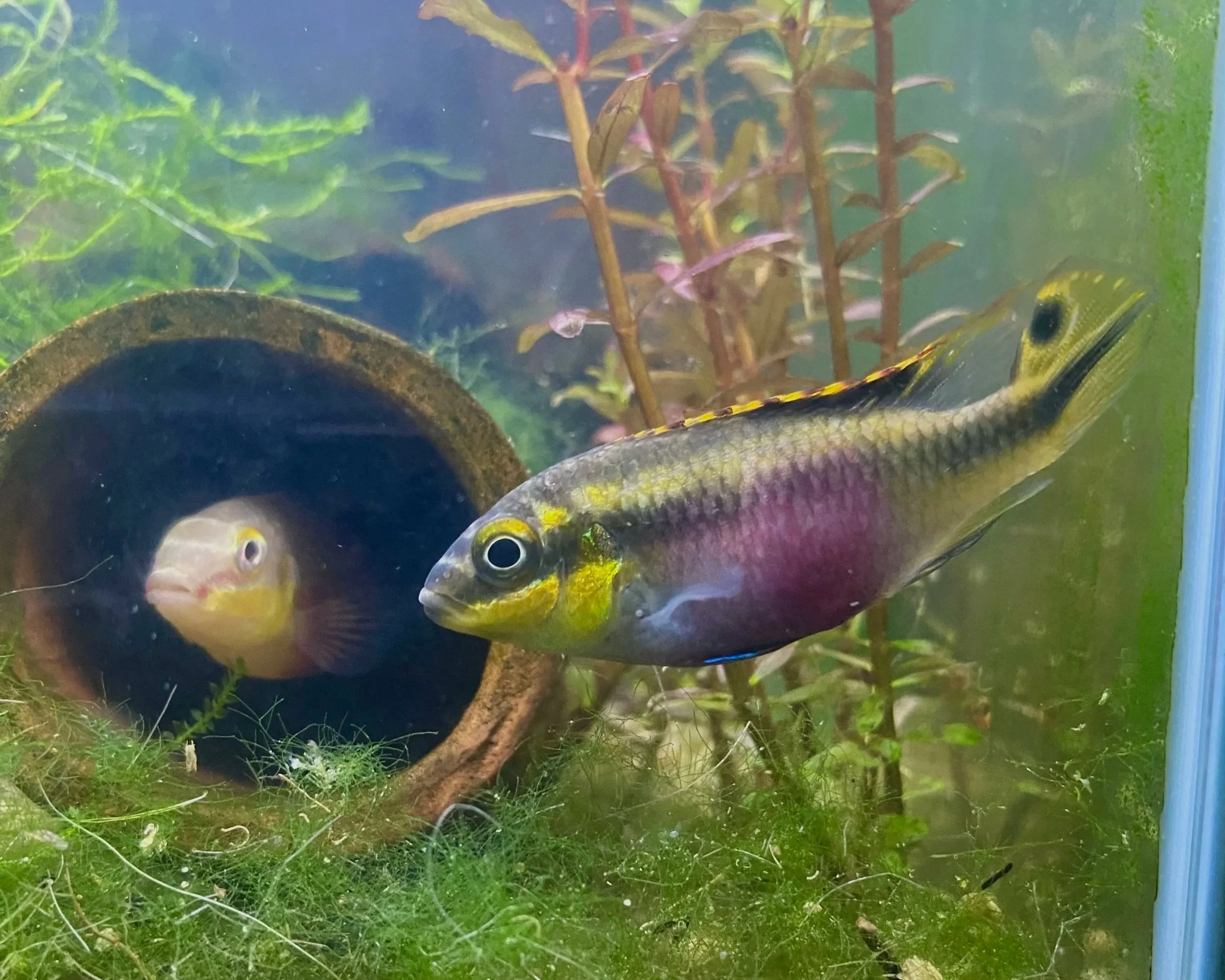
Male Albino Kribensis (Pelvicachromis pulcher) attempting to lure the female into the tunnel to spawn.
One of the biggest advantages of maintaining a microworm culture is reliability. Unlike many live foods that require precise timing or daily preparation, microworms provide a continuous, ready-to-use food source that is always available when needed. Their stable size, slow movement, and high acceptance make them suitable for a wide range of situations, not just planned breeding projects.
Aquariums don’t always operate on schedules. Unexpected spawns, surprise survival of fry in community tanks, or sudden breeding behaviour can occur without warning. Having a microworm culture already established ensures you can begin feeding immediately, rather than scrambling to hatch brine shrimp or source alternative foods during a critical window.
Microworms are also invaluable when dealing with sick, stressed, or newly introduced fish that refuse dry foods. Their movement and scent stimulate feeding responses, while their soft-bodied nature makes them easy to digest, allowing fish to regain strength without additional digestive stress.
Beyond emergencies, keeping a culture on hand supports long-term husbandry. Microworms encourage natural feeding behaviours, improve nutrient utilisation, and can help diffuse excess energy by providing fish with something appropriate to hunt—supporting calmer social dynamics when used preventatively rather than as a response to aggression.
With minimal maintenance required every few weeks, a microworm culture acts as a low-effort insurance policy for your aquarium—ensuring live food is always available when fish need it most, whether for growth, conditioning, recovery, or unexpected life events.
Provides a reliable, continuous, ready-to-use live food source.
Stable size and slow movement make microworms suitable for all life stages.
Perfect for unexpected spawns, surprise fry survival, or sudden breeding behaviour.
Ideal for sick, stressed, or newly introduced fish that refuse dry foods.
Encourages natural feeding behaviours and improves nutrient utilisation.
Can help diffuse excess energy, supporting calmer social dynamics preventatively.
Minimal maintenance every 2–4 weeks makes it a low-effort aquarium.
Live foods do more than provide nutrition — they activate instinctive behaviours that prepared foods often fail to trigger. Consistent access to live prey stimulates courtship displays, territory establishment, and spawning readiness by engaging the physical, nutritional and behavioural needs of the fish. To start you own live food culture today click this link Microworm Starter Culture Australia | Easy Live Food for Fry — Aquarelle Aquatics
